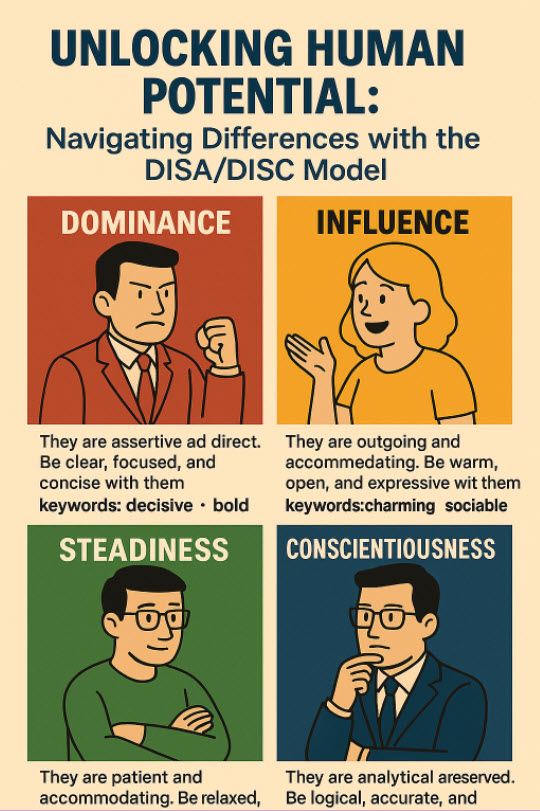
Unlocking Human Potential: Navigating Differences with the DISA/DISC Model
based on a book by Tomas Eriksson
As we navigate our personal and professional lives, we often encounter individuals whose communication styles or behaviors leave us utterly confused, sometimes leading us to label them as difficult or even “idiots”. However, the key insight is that they are simply individuals operating from a different behavioral framework, fully deserving of respect and understanding. To foster this understanding, the behavior profiling method known as DISA or DISC provides a revolutionary tool for describing human communication.
This foundational method is built upon the principles articulated by William Moulton Marston in his work, Emotions of Normal People. It classifies human behavior into four primary types, each associated with a distinct color—Red, Yellow, Green, and Blue—representing how individuals relate to their environment. While human behavior is complex and intricate, understanding these basics can help us avoid the most blatant communication blunders.
The Four Core Behavioral Profiles
Most people exhibit a combination of two dominant colors, though the four fundamental components are studied individually to understand the “ingredients” of a person’s behavior.
| Color | Behavioral Trait | Core Focus | Key Characteristics |
|---|---|---|---|
| Red | Dominance | Tasks and Results | Driven, quick-thinking, ambitious, and competitive. Reds are task-oriented extroverts who make swift decisions and are comfortable taking risks and commanding. They see “quick” as synonymous with “good” and are blunt and honest, often valuing speed and efficiency above all else. |
| Yellow | Inducement/Inspiration | Relationships and Influence | Optimistic, enthusiastic, and relationship-focused. Yellows are lively communicators who enjoy being the center of attention, spread joy, and think outside the box. They are highly persuasive and often make decisions based on gut feeling, as “new” is synonymous with “good”. |
| Green | Submission/Stability | Relationships and Cooperation | Calm, easygoing, dependable, and conflict-averse. Greens are the most common profile; they are excellent listeners and pronounced team players who prioritize the group before the individual. They crave security, stability, and predictability, often resisting fast or unexpected changes. |
| Blue | Analytic Ability/Compliance | Tasks and Process/Quality | Reserved, analytical, cautious, and detail-oriented. Blues seek perfection, valuing logic, accuracy, and facts. They are cautious risk assessors who prefer meticulous preparation, check facts thoroughly, and are guided by rules and regulations. |
The Imperative of Adaptation
The crucial challenge in communication is recognizing that everything you say is filtered through your listener’s frame of reference, biases, and preconceived ideas. What they ultimately understand may be completely different from your intention.
Since the majority of people around you will function differently than you do, simply communicating based on your own preferences is insufficient. Success in life—whether in business, managing a team, or raising a family—requires flexibility and the ability to interpret other people’s needs.
When you adapt your communication style to the listener’s terms, you create a secure arena where they can focus their energy on understanding the message rather than reacting negatively to your mannerisms. This adjustment is a deliberate, learned skill that requires energy and self-awareness, moving away from your natural “core behavior”.
For instance:
- To effectively reach a Red, you must be quick, direct, and stick strictly to the topic, avoiding unnecessary small talk or hesitation.
- To connect with a Yellow, strive to create a friendly, fun atmosphere, focus on big ideas (not minutiae), and appeal to their feelings.
- To move forward with a Green, prioritize stability, provide detailed plans for how things will be done, and avoid introducing conflict or unexpected surprises.
- To win the confidence of a Blue, ensure you are meticulously prepared, stick rigorously to facts and details, and avoid emotional language or visions that lack realistic perspective.
By valuing people for their unique qualities and understanding the basic principles of human behavior, we move away from thinking we are “surrounded by idiots” and instead embrace individuals worthy of respect and tailored engagement. When we meet others in the middle, great competence and understanding can flourish.